
SEO monitoring in France: useful indicators for SMEs
Monitor your SME’s SEO in France with clicks, impressions, queries and enquiries to prioritise useful website improvements.
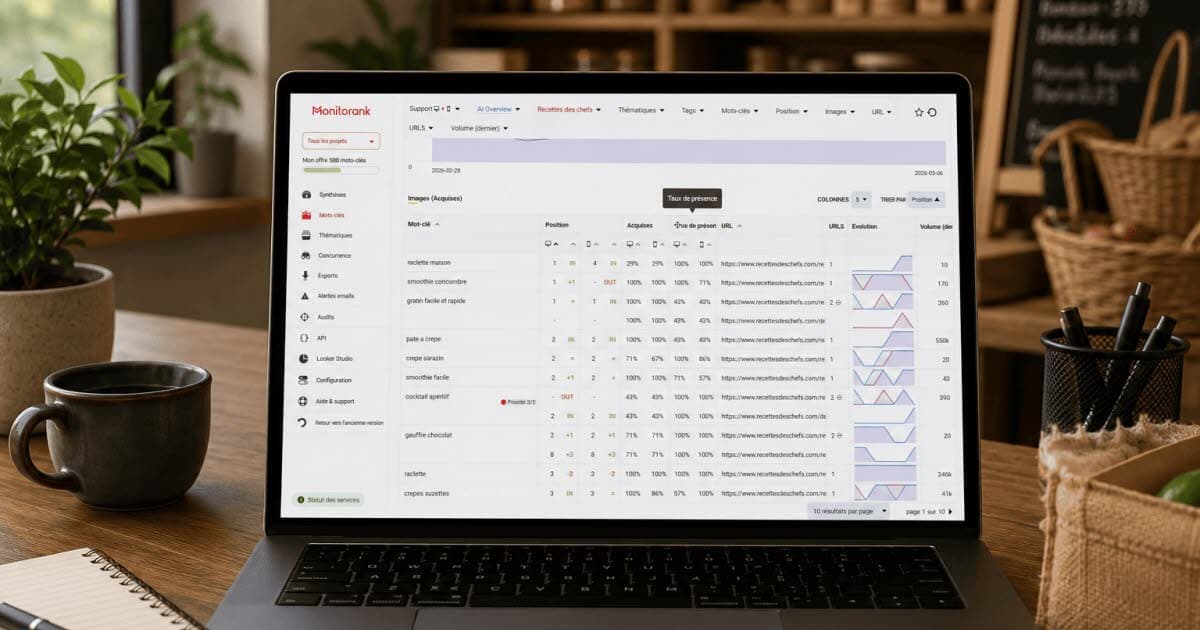
Monitor your SME’s SEO in France with clicks, impressions, queries and enquiries to prioritise useful website improvements.
SEO follow-up: understanding issues and priorities
In the current digital ecosystem, characterized by constant volatility and fierce competition, online visibility is the nerve of war. The algorithms of search engines are constantly evolving, competitors are innovating and user behaviour is changing at a staggering speed. In this context, being satisfied with a weekly or monthly follow-up of your SEO performance is a matter of negligence. For any SME, e-commerce, or SaaS wishing not only to survive but to prosper, a daily analysis of advanced positions and KPIs has become an essential strategy. It allows you to identify opportunities and threats instantly, react agility and strengthen your presence in national and international markets.
For your SME, link Search Console data to applications received and site objectives. Document the changes and compare periods long enough to distinguish a trend from a one-off fluctuation.
Why is a Daily Position Analysis indispensable for your Visibility?
The very idea of daily analysis may seem excessive at first glance. Yet the reality of the web demonstrates the opposite. Positioning fluctuations are not isolated events, but common phenomena, influenced by a multitude of factors:
- Search Engine Algorithmic Updates: Google, Bing and other search engines deploy hundreds of updates per year. Even a tiny change can impact thousands of queries. A decrease in position for a strategic keyword, if not detected immediately via daily analysis, can result in significant traffic and revenue losses.
- Actions of the Competitors: Your competitors are constantly evolving. They publish, optimize, launch campaigns. A daily watch allows you to quickly spot when a competitor gains ground on your target keywords and adapt your own strategy.
- Internal Technical Issues: Slowings (on an overloaded PrestaShop or a poorly optimized React/Angular application), exploration errors, or indexing problems degrade your ranking. A poorly configured or hacked WordPress site can see its content unindexed very quickly. Without daily monitoring, these problems can persist for a long time, causing irreparable damage to your SEO.
- Changes in User Behaviour: Research trends and intentions are changing. A daily analysis allows you to quickly detect these changes and adapt your content or offers.
Example Concrete: Imagine an e-commerce site. An algorithmic update dropped its positions for the keyword "running shoes" from the first to the third page. Without daily monitoring, this decline may not be identified until a week later, after a drastic drop in sales. An immediate warning would have made it possible to investigate, identify the cause and make corrections within a few hours, thus minimizing the financial impact.
Beyond Positions: Advanced KPIs Revealed by Daily Analysis.
Just following the average position of your keywords is a common mistake. If the position is an important indicator, it does not tell the whole story. One daily analysis of advanced positions and KPIs must embrace a wider spectrum of indicators to provide a complete picture of your SEO performance and identify real levers for action:
- Clic Rate (CTR) Organic: A first position with a low CTR may indicate a problem with your title or meta description. A daily analysis allows us to test and optimize these elements quickly.
- Volume and Intent of Research: Monitoring volume evolution and understanding the intent behind this research is crucial. A declining volume transactional keyword could signal a change in seasonality or trend.
- Medium Weighted Positions: This indicator gives a more accurate view of the real impact of your positions by taking into account the search volume.
- Share of Voice: Measure the percentage of total research for your sector that your site captures, essential to assess your dominance and growth opportunities.
- Performance by Request Type and Page: Segmenting analysis by type of keyword (long drag, brand, generic) and page allows to identify content that sub-performs or over-performs. For example, a PrestaShop category page could have stable positions but a low CTR for long drag requests, suggesting a need for content or filters optimization.
- Core Web Vitals and Technical Health: Loading time (LCP), interactivity (FID) and visual stability (CLS) directly impact the user experience and conversions. A drop in these metrics, detected daily, may indicate a performance problem on a Next.js, React or Angular application, or an overloaded WordPress server.
By cross-checking these data, one can move from passive observation to proactive understanding. For example, a SaaS site may find that, despite good positions on informational keywords, its RTC is weak, leading to fewer qualified leads. An in-depth analysis would reveal a need to improve calls for action or the relevance of the content.
Competitive, Technical and Cybersecurity Watch: The 360° Daily Analysis.
One daily analysis of advanced positions and KPIs would not be complete without proactive immersion into the competitive environment and rigorous technical monitoring. These two dimensions are pillars for a robust and comprehensive SEO strategy.
Dynamic competitive watch involves following the positions of your competitors, analyzing their new content and decrypting their strategies (netlinking, social networks). An independent real estate agency can thus identify how its local competitors position themselves on specific neighbourhoods and adjust its service pages accordingly, for example by creating hyper-localized content.
At the same time, technical monitoring is crucial. It includes:
- Indexation and Exploration Status: Ensure that important pages are well indexed and explored. Tags
noindexaccidental or filesrobots.txtMisconfigured can be catastrophic. - Website Performance (Core Web Vitals): A degradation of speed or interactivity can have a direct impact. For an application based on Next.js, a regression could be related to excessive loading of third-party scripts.
- Site Security: Security alerts (expired SSL certificates, SQL injections, malware detection) should be processed immediately. Google severely penalizes compromised sites. A daily monitoring system can detect suspicious activities and generate alerts to protect your WordPress or PrestaShop from common vulnerabilities.
- Internal internal linking and broken links: Good meshing facilitates exploration. Broken links, detected daily, can be fixed before they affect the user experience and SEO.
The integration ofAI applied in this watch is a major asset. Algorithms can analyze thousands of daily data points (positions, Core Web Vitals, server logs, security alerts) and detect anomalies that would escape the human eye. A sudden peak of 404 on key product pages of an e-commerce site, or an unexplained decline in positions for a SaaS platform, can be reported instantly, allowing for proactive intervention.
Automation and AI: The Effectiveness of Daily Analysis of Advanced KPIs.
Realize a daily analysis of advanced positions and KPIs manually is unrealistic for most companies and inefficient. This is where automation and integration of powerful tools, often enhanced by artificial intelligence, come into play to provide unprecedented depth of analysis and responsiveness.
The Crucial Role of SEO Monitoring Platforms:
Specialized platforms collect, organize and visualize huge volumes of positioning data and technical KPIs. They allow granular tracking by location, language and type of device, send personalized alerts for major falls or technical problems, and offer dynamic dashboards for a clear visualization of performance.
Impact of AI and Automation:
AI and machine learning transform SEO analysis by adding a layer of intelligence to raw data:
- Detection of Anomalies: AI can identify abnormal patterns in positioning or traffic fluctuations, indicating an algorithmic, technical or competitive action problem. For example, early detection of an organic traffic drop for a group of specific pages of a WordPress site can alert the team long before the consequences become serious.
- Prediction and Trends: AI helps anticipate research trends, identify new emerging keywords or long-term content opportunities, guiding the editorial strategy of a blog or e-commerce site.
- Content Optimization: AI-based tools can analyze your existing content and suggest optimizations (add keywords, improve structure) to improve its relevance.
- Automated Reports: The generation of customized and regular reports frees up time for strategic analysis.
The integration of these tools with Google Analytics 4 (GA4) and Google Search Console (GSC) is essential. For a site under PrestaShop, this allows you to link SEO performance directly to sales figures. For a site developed with React or Angular, technical optimizations (performance, speed) can be correlated with gains in visibility and user engagement.
From Daily Analysis of Advanced Positions and KPIs to Tangible Growth.
One daily analysis of advanced positions and KPIs is of value only if it translates into concrete actions and proactive strategies. The ultimate goal is not only to observe, but to intervene and optimize to maximize return on investment.
The insights drawn from this intensive monitoring allow several strategic levers to be piloted:
- Content Optimization and Editorial Strategy: By identifying keywords that lose ground or gaps, you can adjust your existing content (enrichment, updating) or create new articles, product sheets, or service pages. For a SaaS site, this could mean creating detailed tutorials based on unsatisfied user queries.
- Technical Improvements to the Site: Alerts about Core Web Vitals, exploration errors or security issues indicate urgent technical interventions. This may include image optimization, the minification of JavaScript and CSS code for a Next.js site, the update of WordPress plugins, or the correction of canonical tags on a PrestaShop. Cybersecurity expertise is becoming crucial here.
- Netlinking Strategy: Understanding the positions of your competitors and the opportunities of keywords can reveal niches for targeted link building campaigns, strengthening the authority of your domain.
- Optimization of User Experience (UX): KPIs such as the rebound rate, correlated with positions, may indicate a UX problem. A well-classified page whose users leave immediately requires a revision of its design or content.
At Codexia, we support SMEs, e-commerce, SaaS and independents in this process. We transform this complex data into clear action plans, whether it's a complete redesign of your site (WordPress, PrestaShop, React, Angular, Next.js), an end-to-end SEO strategy, integration of AI solutions for automation, or proactive technical and security maintenance. Our approach is global and results-oriented, as we know that every position point won and every optimized KPI directly contribute to your online success.
Conclusion
In a digital landscape where immobilism is synonymous with regression, thedaily analysis of advanced positions and KPIs is no longer an option, but an essential compass to navigate and excel. It offers the necessary responsiveness to overcome challenges, the depth of insight to seize opportunities, and the ability to act to advance competition. It is a proactive approach, powered by intelligent tools and human expertise, which allows raw data to be transformed into a sustainable growth engine.
Codexia supports SMEs in France in their SEO monitoring, with a technical audit, structured content and indicators adapted to their activities. Ask for a quote to define the priorities of your site.
To frame the actions adapted to your site, consult our service of SEO audit and optimization or request a quote for your web project.